

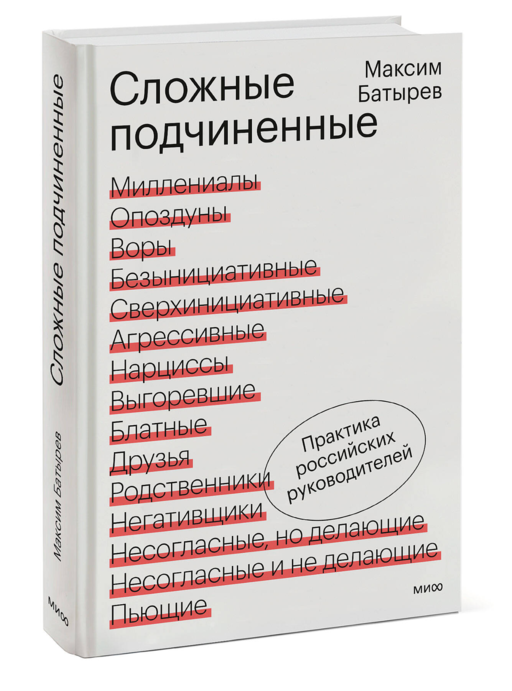
Difficult Subordinates: Practice of Russian Managers
-
AuthorКомбат
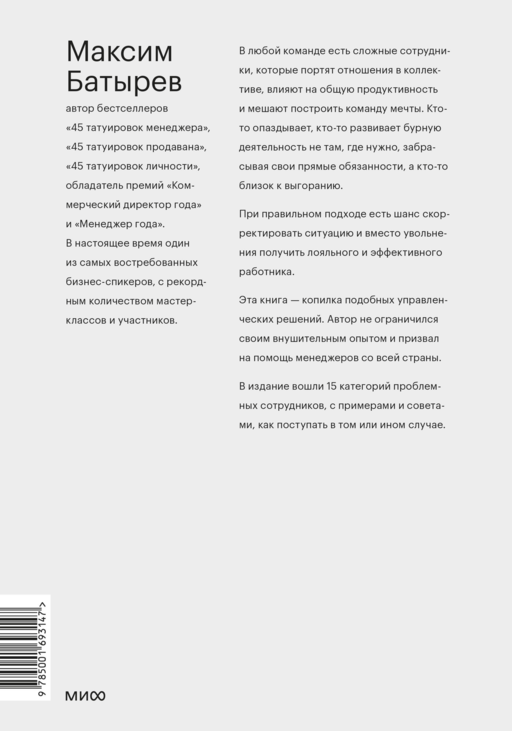
Famous Russian manager Maksim Batyrev wrote a book based on 2000 cases about how to approach difficult employees. Every team has difficult employees who spoil relationships within the team, affect overall productivity, and hinder the building of a dream team. Dismissal is an extreme measure; the well-known Russian manager Maksim Batyrev proposes another way — to find an approach to the problematic subordinate and win him over to your side. Before writing this book, the author collected and analyzed several thousand cases of Russian managers. He identified 15 categories of difficult employees — from latecomers and unmotivated to burned-out and narcissists. These are the main types encountered in every company. Batyrev describes them in the book and explains how to work with them. All advice is proven in practice. Book highlights: Based on more than 2,000 cases from Russian managers Each chapter is devoted to one employee type Includes examples and advice for problem-solving Who this book is for: For all managers interested in real Russian experience and who want to not fire difficult employees but improve them and help them. For employees who want to influence their colleagues and themselves. For fans of Maksim Batyrev's work. From the author: Once I had the idea to write a book collaboratively, relying not only on my own lived experience but also on the experience of other practitioners, people who manage their teams daily, lead their companies to results, and build a Dream Team from their employees. Agree that learning from successful people who have gone through the challenging path of a manager and solved many tasks is always interesting. So I chose the topic for the book and appealed to everyone who knows me with the following request: "Friends, if on your management path you have encountered a difficult employee who for different reasons interfered with your creativity and productivity, and your managerial decisions created such conditions that the employee still switched to your side, write to me about your solution, and I will publish it in the book." I received more than 2,000 stories in response. Believe me, that's a lot. Unfortunately, most of them were of the following kind: "I had a difficult subordinate... (then a long story about how the subordinate annoyed the manager), and in the end, I fired him and breathed normally!" Firing a person is, of course, a managerial decision, but I wanted the book to show how managers managed to change the person so that he switched to the side of good. And if it doesn't work, then to do something else to change his worldview. And if that is impossible, then to come up with another solution. Only then think about terminating employment relations. Therefore, stories about "how I fired him" are minimal here, and only in cases where it was truly necessary.